COMBUSTION AIR
There are many different elements I inspect when examining gas furnaces- leaks, missing drip-leg and shut-off valve, rusting, inappropriate materials, burner flame patterns, heat exchanger damage etc. Another thing I check is the presence of combustion air.In older homes, I find gas furnaces in small, poorly vented closets, but sometimes, even an enclosed garage with a gas water heater, gas furnace, and gas dryer may not have adequate combustion air.
For a furnace to work properly, it must have an adequate supply of combustion air to ‘feed’ the furnace. Gas furnaces also require a secondary source of air (‘draft air’) to maintain an appropriate exhaust - to help maintain chimney draft.
What’s an adequate supply of combustion air?
Standard of practice is 50 cubic feet of air for every cubic foot of gas (i).
If a gas furnace is rated at 100,000 BTU’s per hour, it will burn approximately 100 cubic feet of gas per hour (one cubic foot of natural gas contains about 1,000 BTUs).
Therefore, it will need approximately 5,000 cubic feet of combustion air.
Total appliance BTU’s / 1,000 x 50 = cubic feet required
As you can see, a small closet that has no door vent, and a small opening in the ceiling, may not have enough combustion air for the furnace to function correctly.
Why is this important?
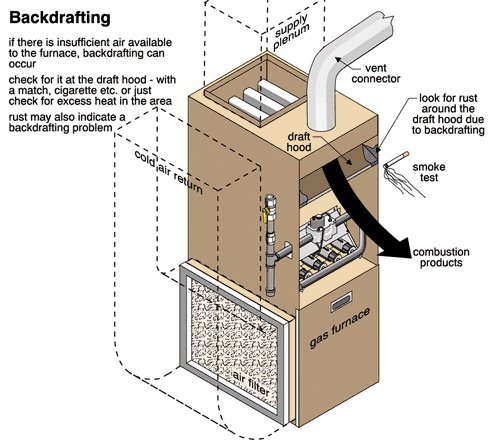
Inadequate air intake can lead to increased levels of carbon monoxide (CO- a poisonous gas). Secondly, a lack of ‘draft air’ is likely to result in backdraft. This means combustion product (CO) can go back in to the room, rather than up the chimney/flue (because the room is under low pressure having been starved for air because its been pulled in to the furnace for the combustion and dilution process).
To test for backdrafting, you can put your hand in to the base of the draft-hood, you should be able to feel cool air being drawn in. If you feel hot, wet exhaust air, then spillage/backdrafting is taking place. Rust around the draft hood may also indicate a chronic backdrafting problem.
Making sure a gas furnace (and other gas appliances) have appropriate combustion air is crucial to the safety of the home owner.
Helpful links-
http://osfm.fire.ca.gov/strucfireengineer/pdf/bml/Frequently%20asked%20questions%20on%20Carbon%20Monoxide.pdf
http://www.homesafe.com/coalert/detect.htm
Source (i): Principals of Home Inspection, Carson Dunlop & Associates, 2008

